
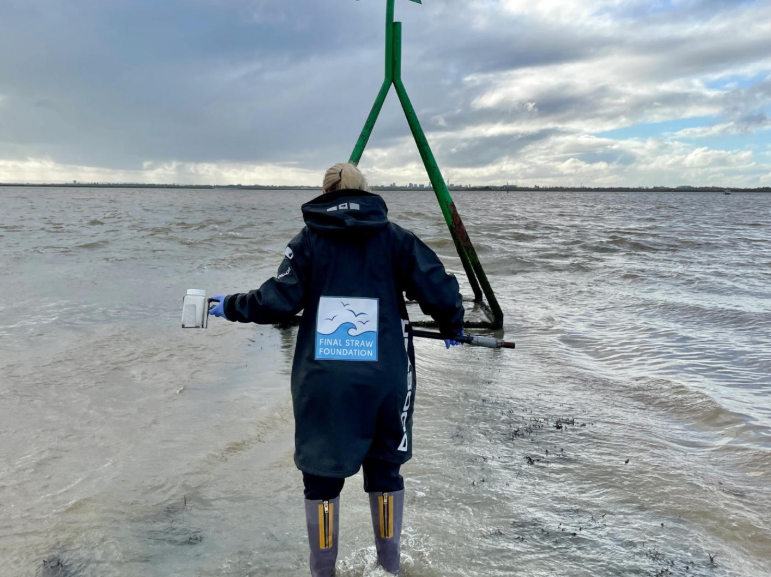
As a founding partner of the Clean Harbours Partnership, the Final Straw Foundation is at the forefront of investigating and improving water quality in Chichester and Langstone Harbours and beyond. In a study published in Environment International (Read here), the Clean Harbours Partnership, along with Brunel University of London, the University of Portsmouth, and Imperial College London, have discovered some worrying truths about the state of our harbours and the chemical pollution within them.
As part of this citizen science project, volunteers and researchers took 339 samples across Langstone and Chichester Harbours in the spring and autumn of 2022. 105 unique compounds were detected in seawater, seaweed and shellfish. Labelled, ‘contaminants of emerging concern’, the concoction of compounds included 67 pharmaceuticals, 29 pesticides and 9 recreational drugs. Shockingly, the presence of some of these contaminants increased by over 100 fold in water after there had been sewage discharges from either Budds Farm, Bosham, Thornham and/or Chichester sewage treatment works.

In the last couple of weeks, the Environment Agency released data exhibiting that there was raw sewage released into England’s rivers and seas for a whopping 3.61 million hours last year. Coastal waters have historically been studied at a lesser rate than rivers, this new study shines a light on undeniable damage that these releases are doing on our precious coastal ecosystems.
Of the contaminants discovered, 9 of the pesticides were those that are no longer approved for agricultural use, with some being banned over a decade ago. This points to the fact that these pollutants could have originated from somewhere other than farming, or may be what’s known as legacy pollutants. Legacy pollutants are compounds that don’t break down easily, remaining in the environment for an extended period after their original release. They can biomagnify when ingested or absorbed by wildlife, increasing in concentration as they move up the food chain. This is extremely concerning when you consider the delicate ecosystems of the harbours, with both being Sites of Special Scientific Interest. Biomagnification may be of particular concern in the harbours, as seaweed, which is at the bottom of the food chain for many marine ecosystems, was found to have absorbed more of the contaminants than shellfish.
“It’s concerning to see such a large cocktail of chemicals being detected—and even more worrying that their effects are still largely unknown.”
Rob Bailey, Clean Harbours Partnership
The compound which was found at the highest levels in surface water was imidacloprid. This insecticide is used as a topical flea and tick treatment for domestic pets. These findings raise questions about blanket treatment for pets, and whether more natural or targeted approaches to pet parasite treatment are needed.
Another notable contaminant found was 1,3 diphenylguanidine, found in rubber. The presence of this vulcanisation accelerator suggests pollution from road runoff may be affecting the harbours. Again, this is extremely concerning as 1,3 diphenylguanidine has been classified as toxic to aquatic life.
Overall, the effects on marine life of the compounds in the chemical cocktail found in the harbours are widely unknown. Further study is needed to determine how the fragile marine ecosystems have been and will be impacted by the pollutants that have been found there. In the meantime, more work needs to be done to clean up the harbours and prevent continuing sewage spills. Final Straw Foundation will be at the forefront of this vital work.
Please let us know if you’d like to get involved in helping us clean up our harbours and wider oceans.

You must be logged in to post a comment.