A core value here at Final Straw Foundation is education and empowering future generations to love and care about our waters just as much as we do! Not only is this reflected within our beach schools, but also in our internships, and we have had the pleasure of being joined by William this summer to intern alongside our Restoration Project Intern, Victoria, on our European Flat oyster project.
After spending 7 weeks with us, our Restoration Project Lead, Hannah, sat down and asked William a few questions about his time with us and his future aspirations as a marine conservationist.
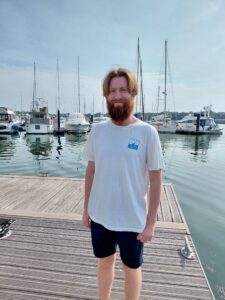
William
Tell us about your studies: what uni are you at, what are you studying and how far through your studies are you?
I am studying a BSc in Marine Biology at the University of Southampton. I am currently in my second year and have studied a handful of subjects, such as Marine Invertebrates, Marine Ecology and Evolution, Functional Marine Biology, and Physics of the Ocean.
What inspired you to apply for an internship with FSF?
Being able to gain hands-on experience within Marine Biology can be a challenge, especially as a student, so when the internship for Final Straw Foundation was brought to my attention through my university, I was instantly keen to apply. I have previously been a part of a research project regarding oysters (it was unfortunately the Pacific oyster and not our native oyster), but this gave me some knowledge regarding their habits and biology. When I saw that this project was specifically for the European Flat oyster and that it entailed fieldwork experience, I was excited as I could put some of my knowledge from my previous work into practice.
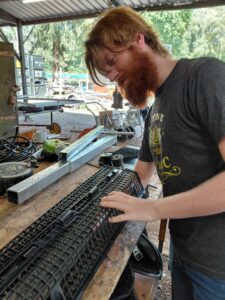
William building the Oyster cages
What has been your favourite part of the internship?
The biodiversity survey was the highlight of the whole internship! While recording
measurements of the oysters growth, we also looked at and documented the life that was hosted around them. Due to oysters being ecosystem engineers, biodiversity flourishes around them, and I think this is what every Marine Biologist dreams of. To see firsthand their environment and its abundance with a vast amount of different creatures, all different sizes, with some incredibly rare species that I have never had the chance to see before. Those three days were incredible.
How has the internship helped you develop skills you will need for your future career?
I have developed a handful of skills through my internship that I can carry forward in my career. I have learned to problem-solve by tackling last-minute issues; my mathematics skills have developed through calculating basket dimensions, and my physical skills were put to the test through basket making and deploying. All of this contributes to the many areas of conservation that I wish to work in.
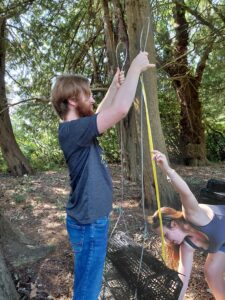
William working with Hannah, measuring the length of the Cables for the Oyster Cages
What is one thing you’ve learned during your internship that you’d like to share with others?
It’s not all rainbows and sunshine! Most people think of Marine Biology as wonderful sunny days on boats, but in reality, we were on our hands and knees on pontoons covered in mud. Not all of it is glamorous, to be honest; most of it isn’t, but it is essential work that needs to be done.
What has the internship taught you about the world of nature restoration and working for a charity?
Working for a charity, especially a small one that has such large ambitions, means you have to wear many different hats. The people I worked with had so many different responsibilities within their main role, however, each person had skills and capabilities that meant they could help each other out when needed. For example, Hannah is the charity’s restoration manager and works on the biodiversity projects; however, she would help out the education team with beach schools if they were short-staffed or just needed an extra pair of hands! I realised that you need to be multi-talented and juggle a lot of different jobs within this industry. Also, restoration work seems to be particularly tough, there is a lot of
behind-the-scenes work that I wouldn’t have known about without completing this internship. Despite the grimy and gritty parts of the job, the special moments are definitely worth it – like completing the biodiversity surveys when I saw some rare species and even seals!
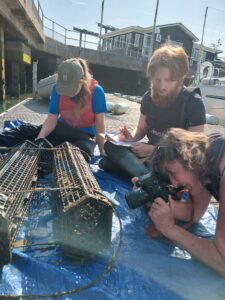
William helping survey the oysters
Would you recommend interning with FSF to other students? Why?
YES! Everyone at FSF is incredible; they’re a brilliant team that wants nothing but the best for both your career and personal life. They encourage self-development and will support you in any way that they can. To be able to say that I have had a part in restoring our native oyster species is something that I will cherish, and seeing restoration work firsthand has been an amazing experience. I would like to thank everyone at Final Straw Foundation for taking me on as a summer intern and for being so friendly. I will carry these past couple of months with me into my career and I wish everyone all the best!