Water Quality Testing
About SQIRT
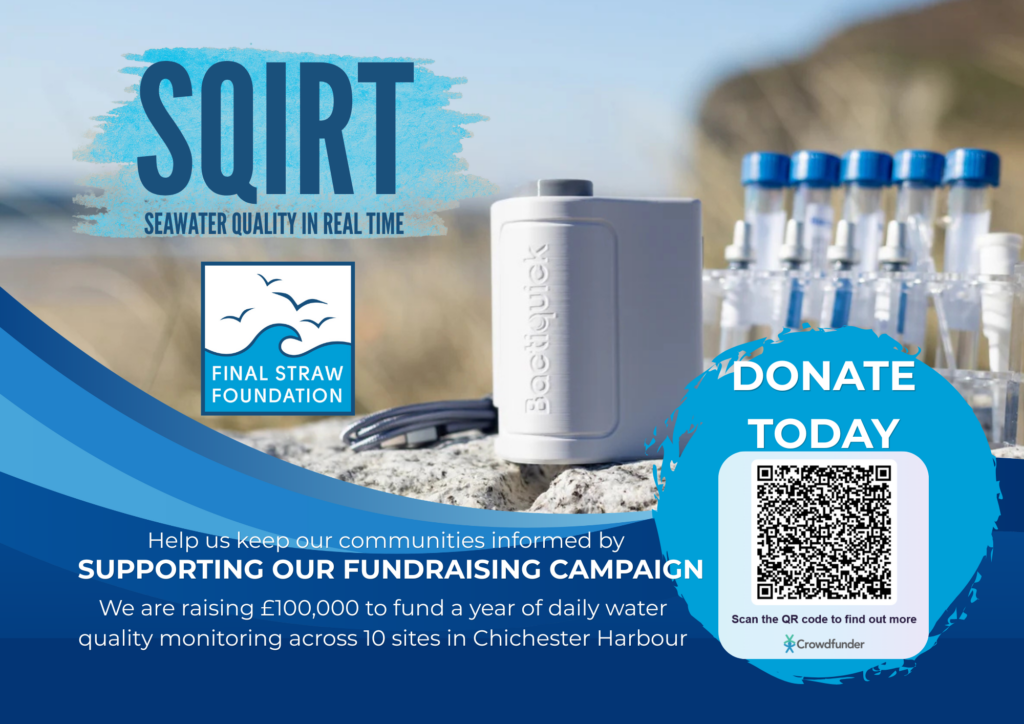
SQIRT (Seawater Quality in Real Time) is an innovative seawater quality monitoring programme developed by Final Straw Foundation to provide independent, near real-time information about coastal water quality.
By carrying out daily seawater testing, SQIRT helps improve public awareness of bacterial contamination, supports informed decision-making for swimmers, paddleboarders, sailors and other water users, and builds a valuable long-term dataset to improve our understanding of the health of our coastal waters.
Our vision is to create one of the UK’s largest community-led seawater quality monitoring networks, delivering transparent, accessible water quality information for everyone.
Our Monitoring Locations
SQIRT currently operates across 10 monitoring locations within Chichester Harbour and the surrounding coastline, with further expansion planned across Portsmouth Harbour, Langstone Harbour, Southampton Water and the Isle of Wight.
Current monitoring locations
- Emsworth Jetty
- Hayling Island – Inn on the Beach
- Bosham
- Cobnor Activities Centre
- Bracklesham Bay
- West Wittering Beach – Beach
- West Wittering Beach – East Head
- Chichester Yacht Club
- Dell Quay Sailing Club
- Itchenor Sailing Club
These locations have been carefully selected to represent some of the Solent’s most popular swimming, sailing and water sports destinations, helping provide valuable information for local communities and visitors while building a comprehensive picture of seawater quality across the region.
More sites are coming on board in 2027.
The Equipment
SQIRT uses BactiQuick® rapid testing technology to measure Endotoxin Risk Units (ERUs)—an indicator of contamination from Gram-negative bacteria commonly associated with sewage pollution.
Endotoxins are naturally released by Gram-negative bacteria and provide a rapid indication of bacterial contamination within a water sample. Rather than identifying individual bacterial species, BactiQuick measures the overall endotoxin burden, allowing potential pollution events to be identified in approximately 15 minutes.
Unlike traditional laboratory testing, which can take between 24 and 72 hours to return results, BactiQuick enables near real-time seawater quality monitoring, providing timely information for water users when they need it most.
Samples are collected by trained volunteers following a standardised sampling protocol to ensure consistency and reliability across the monitoring network.
Reporting Results
Once a sample has been analysed, results are uploaded directly to the SQIRT platform and made publicly available shortly afterwards.
Each result is displayed using a simple traffic-light system, together with the measured Endotoxin Risk Unit (ERU) value, the date and time of testing and the monitoring location.
By providing independent, transparent and near real-time seawater quality information, SQIRT enables water users to make informed decisions before entering the water while creating one of the UK’s most comprehensive long-term community datasets on coastal water quality.
Understanding Your Result
SQIRT reports results as Endotoxin Risk Units (ERUs) using a simple traffic-light system to help water users quickly understand the level of bacterial contamination detected in the seawater.
The ERU thresholds have been calibrated against approximate bacterial concentrations equivalent to the UK’s bathing water standards, providing an easy-to-understand indication of seawater quality while delivering results in approximately 15 minutes.
GREEN – LOW RISK
Approximate bacterial concentration equivalent
Less than 250 CFU equivalent
The result indicates low levels of bacterial contamination and seawater quality generally consistent with good bathing conditions.
AMBER – ELEVATED RISK
Approximate bacterial concentration equivalent
250–500 CFU equivalent
The result indicates increased bacterial contamination. Most healthy adults may still choose to enter the water, but young children, older adults, people with weakened immune systems, or those with open cuts or wounds should consider exercising additional caution.
RED – HIGH RISK
Approximate bacterial concentration equivalent
Greater than 500 CFU equivalent
The result indicates a high level of bacterial contamination, suggesting an increased likelihood of sewage-related pollution. Water users should carefully consider the results before entering the water, particularly those at greater risk of illness.
Please note: The bacterial concentration equivalents shown above are based on the calibration of Endotoxin Risk Units (ERUs) against bacterial levels associated with the UK’s bathing water standards. SQIRT uses rapid endotoxin testing to provide independent, near real-time seawater quality information and is designed to complement, not replace, the Environment Agency’s official Bathing Water Programme.
Please note: CFU = Colony Forming Units, a standard laboratory measure used to estimate the number of viable bacteria in a sample
Every result displayed on the SQIRT platform includes both the numerical ERU value and the corresponding traffic-light rating, allowing users to understand current seawater quality at a glance, while also tracking changes over time.
Important Information
SQIRT provides independent, near-real-time seawater quality information using rapid endotoxin testing technology. The project is designed to complement, not replace, the Environment Agency’s official Bathing Water Programme.
While the Environment Agency assesses bathing waters through laboratory analysis undertaken throughout the bathing season, SQIRT provides an additional source of independent information by delivering results within approximately 15 minutes. This enables communities to better understand changing seawater conditions on the day they visit the coast.
Together, these two approaches provide a more complete picture of seawater quality, combining long-term regulatory monitoring with rapid, community-led testing.
Why It Matters
Millions of people enjoy the Solent and our harbours every year, yet seawater quality can change rapidly following rainfall, sewage discharges and other environmental events.
SQIRT provides communities with accessible, independent information to help people better understand changing seawater conditions. Alongside supporting informed decision-making, the programme contributes valuable environmental data that supports research, education and the long-term protection of our coastal ecosystems.
By making seawater quality information freely available to everyone, SQIRT is helping create more informed coastal communities.
Disclaimer: We provide water quality data to empower users to make their own personal decisions. The availability of this information does not imply a recommendation to use or not use the water. Please use your own judgement or consult local authorities for specific safety guidance.
The Solent 365 Water Quality Report: Building a Bigger Picture